Jury awards Baker Valley couple $56K in B2H case
Published 2:50 pm Friday, March 6, 2026
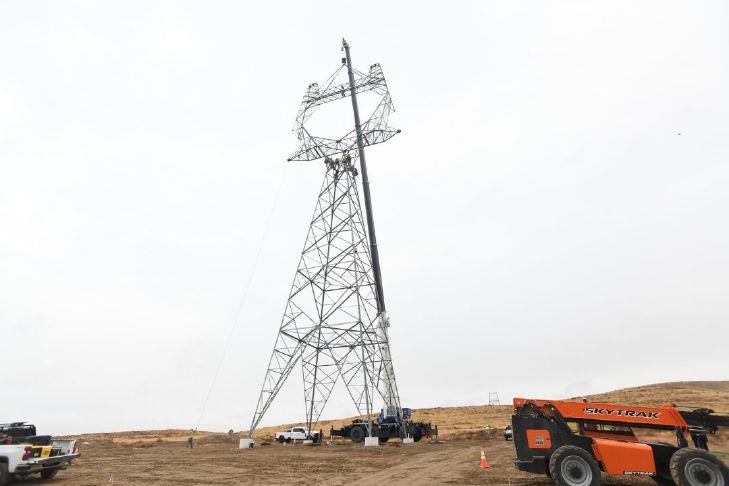
BAKER CITY — A jury decided Idaho Power Co. should pay a Baker Valley couple $56,000 for the use of their property, and the loss in its value, for the Boardman to Hemingway power line.
The seven-man, five-woman jury, which started deliberating around 10:30 a.m. on Friday, March 6, after a trial that started Monday, gave its verdict about 3 p.m. in Baker County Circuit Court.
At least nine jurors had to agree on the verdict. Judge Matt Shirtcliff said 10 jurors were in favor of the verdict, two opposed.
Idaho Power, which is building the B2H project now, including on the 1,050-acre property that Mark and Savannah Kerns own on the east side of Baker Valley, about 5 miles northeast of Baker City, proposed to pay the couple $27,810.
The Kernses, represented by Andrew Martin and David Auxier, had asked for $215,694.
Neither the Kernses, nor Tim Helfrich, the Ontario attorney representing Idaho Power, had a comment after the verdict.
Helfrich thanked the jury for its service.
“We all owe them a debt,” he said.
This week’s trial was the first related to the more than 15 condemnation lawsuits Idaho Power filed in 2023 and 2024 for the 293-mile Boardman to Hemingway power line.
The company hopes to finish the $1.15 billion project by the end of 2027 or early 2028.
Work started on the line last fall. It passes through sections of Malheur, Baker, Union, Umatilla and Morrow counties.
Judge Shirtcliff last year granted the company the right to use the properties, including the Kernses, while the lawsuits proceeded.
The company paid the couple $26,070 last year for that advance occupancy.
Condemnation, also known as eminent domain, gives the government or, as in this case, a private company the right to use private property for public projects such as roads and power lines.
The U.S. Constitution requires, though, the government or a private company pay the landowner for using the property.
Several other lawsuits involving property in Baker County are pending, and more trials, as early as late March and early April, are possible.
Although the properties are different, the basic issue is the same — how much Idaho Power should pay the landowners.
That compensation is based on two things — the value of the land the company needs for the actual construction and access roads, and any reduction in value of the entire property due to the power line.
The amount of land in the easements is generally a small percentage — about 3% in the Kernses’ case.
Closing arguments
During his 15-minute argument, Auxier told jurors “this case is about the towers.”
Auxier said the construction of those towers, which is underway, “basically ruins” the property the couple bought in 2021.
Auxier said the towers and power lines will have a “serious visual impact” marring the view west to the Elkhorn Mountains, including from the site where the couple has considered building a home.
“Nobody wants that, and that’s being completely ignored by Idaho Power,” Auxier said.
He conceded the power line doesn’t preclude the Kernses from building a home on their property.
But Auxier told jurors the towers in particular, and their effect on the view, would discourage anyone from wanting to build a home.
Auxier told jurors the situation, in which Idaho Power is using the legal authority known as condemnation, or eminent domain, to acquire easements across the Kernses’ property, “reminds me of the old Soviet Union.”
The company, Auxier argued, is implying with its offer to pay the couple $27,810 that the only effect on the property’s value is within the easements for the power line, access road and construction areas. Those areas total about 25.5 acres, or around 3% of the total parcel.
Auxier said it’s “absurd” to think that once a person steps outside the easement, the effect of the power line goes away.
He told jurors it’s “patronizing” to pretend the power line, which Idaho Power wants to finish by the end of 2027 or early in 2028, affects only the portion the company is using.
“This is what bureaucrats do,” Auxier said.
He argued the power line will “destroy” the “highest and best use” of the couple’s property — building a home and recreation.
He told jurors “just compensation” for the Kernses is $215,694, an amount that includes the value of the easements — about $17,500, which the two sides don’t disagree about — and about $197,000 for the diminished value of the rest of the parcel.
That figure is based on testimony from appraiser Benjamin Ward, a witness Auxier and Martin called and who contends the construction of the power line reduces the value of the property by 25%.
“Don’t check your common sense at the door,” Auxier urged jurors.
In his 57-minute argument, Helfrich chastised Auxier for comparing Idaho Power to the former Soviet Union.
“There’s no reason to be vilifying Idaho Power Co.,” Helfrich told the jury. “These are your fellow citizens. It is simply wrong.”
Helfrich pointed out the decision about compensating the Kernses “is not going to be decided by a Communist bureaucrat, it’s going to be decided by a jury.”
Helfrich argued using “subjective” matters such as views of the Elkhorns to determine compensation is “irrelevant” despite what he termed Auxier’s “eloquent description.”
Helfrich emphasized to jurors that even with the power line in place, the Kernses could build a home, continue to use the property to graze cattle, and use their land for any other purpose so long as it doesn’t conflict with Idaho Power’s operation of the power line.
He noted power lines, once built, “basically sit there,” and Idaho Power would not use the property often.
Helfrich also noted there is an existing power line through the property, which was built in 1955.
Helfrich argued Ward’s conclusion that the B2H project would reduce the value of the Kernses’ property by 25% is not trustworthy. He noted Rouke Aboubacar, the property appraiser Idaho Power called as a witness, studied about 16 pairs of properties, one of which had a power line through it and one without. Aboudacar concluded the presence of a power line has no effect on a property’s value, Helfrich told jurors.
He pointed out the current power line has 10 towers on the Kernses’ property, although these are shorter, at about 70 to 80 feet, than the towers that will be built for B2H.
Helfrich told jurors the Kernses “are nice people,” but he urged jurors to consider Aboubacar’s conclusions rather than the subjective issues he said Auxier used in his argument.
“Don’t let these kinds of emotional arguments be part of your analysis,” Helfrich said.
In a four-minute rebuttal, Auxier told jurors the presence of the towers — what he called the “aesthetic value, absolutely relates to the fair market value” of the property, the value that determines how much Idaho Power should pay the couple.
Auxier described the towers as “gargantuan.”
About Jayson Jacoby | Baker City Herald

Jayson has worked at the Baker City Herald since November 1992, starting as a reporter. He has been editor since December 2007. He graduated from the University of Oregon Journalism School in 1992 with a bachelor's degree in news-editorial journalism.
 More by Jayson Jacoby